8 Best Dehumidifiers for Basements (October 2026)
The best dehumidifiers for basements include the AEOCKY 80 Pint Dehumidifier for large, damp basements, the KNKA 80 Pint Dehumidifier for quieter large-space use, and the AEOCKY 50 Pint Quiet Dehumidifier for a basement near living areas.
On this page (5 sections)
The AEOCKY 80 Pint Dehumidifier is the best dehumidifier for most large, damp basements because it combines high stated moisture removal with an included drain hose. Consider the KNKA 80 Pint Dehumidifier for its stated 40–45 dB noise range, or the Kesnos 2,500 Sq Ft Dehumidifier for lower-capacity needs.
A basement's area is only part of the choice. Persistent dampness, drainage access, room temperature and how often you can empty a tank all affect which unit makes sense.
Use our dehumidifier size guide if you haven't matched capacity to the space yet. For placement and target settings, see where to put a dehumidifier in a basement and what humidity level is good for a basement.
Our picks at a glance
-
1

-
2

-
3
 Best for a basement near living areas
AEOCKY 50 Pint Quiet Dehumidifier
8.6/10 our score
See it on Amazon
- 4
 Check it
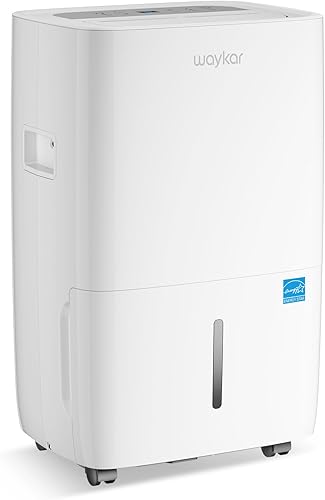
Waykar 80 Pint 5,000 Sq Ft Dehumidifier
Best for wide airflow coverage - 5
 Check it
Kesnos 2,500 Sq Ft Dehumidifier
Best for medium basements - 6
 Check it
VEAGASO 34 to 36 Pint Dehumidifier
Best for simple mode changes - 7
 Best for app and voice controlCheck it
- 8
 Best for a larger tank in a lower-capacity unitCheck it
How we chose these basement dehumidifiers
We ranked these basement dehumidifiers by how their specs and features fit basement moisture control. We favored models with a practical way to drain collected water, since a small tank can fill often in a damp space.
Capacity figures are not directly interchangeable because brands give them under different temperature and humidity conditions. The two 80-pint AEOCKY and KNKA models provide figures at both 95°F and 95% RH and 86°F and 80% RH.
Our score weighs specs and features against what basement shoppers need. Noise, coverage and moisture-removal figures are manufacturer claims, and differences in measurement conditions limit comparisons.
Compare the best dehumidifiers for basements
Capacity, drainage and controls are the main differences between these basement picks. Use the table to narrow the field, then check the individual fit notes below.
| Product | Best for | Capacity | Coverage | Drainage | Our score |
|---|---|---|---|---|---|
| AEOCKY 80 Pint Dehumidifier | large, damp basements | Up to 80 pints per day at 95°F and 95% RH | Up to 5,500 sq ft, according to AEOCKY | Tank or included drain hose | 9.2 |
| KNKA 80 Pint Dehumidifier | quieter large-space use | Up to 80 pints per day at 95°F and 95% RH | Up to 5,500 sq ft, according to KNKA | 1.45-gallon tank or drain hose | 8.9 |
| AEOCKY 50 Pint Quiet Dehumidifier | a basement near living areas | Up to 50 pints per day at 95°F and 95% RH | Up to 3,500 sq ft, according to AEOCKY | 0.8-gallon tank or drain hose | 8.6 |
| Waykar 80 Pint 5,000 Sq Ft Dehumidifier | wide airflow coverage | Up to 80 pints per day at 95°F and 90% RH | Up to 5,000 sq ft, according to Waykar | 1.14-gallon tank or drain hose | 8.6 |
| Kesnos 2,500 Sq Ft Dehumidifier | medium basements | Up to 30 pints per day at 95°F and 90% RH | Up to 2,500 sq ft, according to Kesnos | 0.39-gallon tank or drain hose | 8.5 |
| VEAGASO 34 to 36 Pint Dehumidifier | simple mode changes | 34 pints per day stated capacity | Up to 2,500 sq ft, according to VEAGASO | 0.53-gallon tank or drain hose | 8.4 |
| Midea 50 Pint Dehumidifier | app and voice control | Up to 50 pints per day | Up to 4,500 sq ft, according to Midea | 1.6-gallon tank or hose connection | 8.0 |
| KNKA 34 Pint Dehumidifier | a larger tank in a lower-capacity unit | Up to 34 pints per day at 95°F and 90% RH | Up to 2,500 sq ft, according to KNKA | Tank, drain hose or optional external tank | 8.0 |
The best basement dehumidifiers by use
The AEOCKY 80 Pint Dehumidifier leads our picks for large, damp basements, while lower-capacity models may suit smaller moisture loads. The right fit also depends on remote controls, noise and the route to your drain.
AEOCKY 80 Pint Dehumidifier
- 80 pints per day at 95°F and 95% RH
- 56 pints per day at 86°F and 80% RH
- 1.45-gallon tank
- Drain hose included
Its high stated removal capacity and included drain hose suit a large basement where moisture is persistent. A 1.45-gallon tank is available when you can't use continuous drainage.
Pros
- High stated daily capacity
- Drain hose and garden hose adapter included
- Adjustable humidity control
Cons
- Tank may need frequent emptying without a drain
- Large capacity may be more than a modest basement needs
The AEOCKY 80 Pint Dehumidifier is the strongest fit here for a large basement with sustained moisture. AEOCKY states removal of 56 pints per day at 86°F and 80% RH, alongside its 80-pint maximum at 95°F and 95% RH.
It has a 1.45-gallon tank, and a drain hose and garden hose adapter are included. Continuous drainage is useful when a suitable drain is nearby; otherwise, check the tank regularly during humid periods.
AEOCKY equips this model with defrost sensors for cooler conditions. Its stated low-fan-speed noise figure is 44 dB, which may be noticeable in an open-plan or frequently used basement.
Choose it when your basement is large or persistently damp and you can use the drain hose. For a smaller moisture load, a 30- or 34-pint model may be a better match.
KNKA 80 Pint Dehumidifier
- 80 pints per day at 95°F and 95% RH
- 56 pints per day at 86°F and 80% RH
- 40–45 dB stated noise level
- 6.56 ft drain hose
This model combines a 6.56 ft included drain hose with KNKA's stated 40–45 dB operating range. Its display measures humidity at the air inlet, so readings can differ from a separate hygrometer.
Pros
- High stated capacity
- 6.56 ft drain hose included
- Washable filter
Cons
- Optional external tank sold separately
- Humidity reading is taken at the air inlet
The KNKA 80 Pint Dehumidifier pairs high stated capacity with 40–45 dB operation and a 6.56 ft drain hose. KNKA states removal of 56 pints per day at 86°F and 80% RH, matching AEOCKY's stated capacity at those conditions.
Its 1.45-gallon tank is available for manual drainage. KNKA also offers an optional external tank separately, but the included hose is useful for long runs if your drain is close enough.
The humidity display reads air at the inlet, and a separate hygrometer may show a slightly different result. If you're trying to monitor one corner of the basement, measure there as well.
This model suits buyers who want high stated capacity and a 6.56 ft included hose. Compare it with the AEOCKY 80-pint dehumidifier review for a closer look at our highest-scoring pick.
AEOCKY 50 Pint Quiet Dehumidifier
- 50 pints per day at 95°F and 95% RH
- 38 pints per day at 86°F and 80% RH
- About 40 dB stated noise level
- 2 m drain hose included
AEOCKY's stated noise level of about 40 dB makes this worth considering for a basement near a work or living space. The small tank makes continuous drainage useful during long runs.
Pros
- About 40 dB stated noise level
- Drain hose and garden hose adapter included
- Adjustable humidity control
Cons
- Small tank may need frequent emptying
- Lower stated removal capacity than the 80-pint options
The AEOCKY 50 Pint Quiet Dehumidifier suits a basement near living areas, with AEOCKY claiming about 40 dB operation even at its highest dehumidification setting. AEOCKY claims coverage up to 3,500 sq ft and removal of 38 pints per day at 86°F and 80% RH.
The 0.8-gallon tank may need frequent emptying when moisture removal is high. Use the included 2 m drain hose for extended operation when the layout allows, and keep the tank installed during hose use.
The unit also includes automatic defrost for cooler environments. Leave room for airflow and access to the tank and controls when choosing its position.
Choose this model when the basement is near a living area and its stated noise level appeals to you. Its removal figures are below those of the two leading 80-pint models at the same temperature and humidity conditions.
Waykar 80 Pint 5,000 Sq Ft Dehumidifier
- 80 pints per day at 95°F and 90% RH
- 90° auto-swing airflow
- 30%–80% humidity control
- Drain hose included
Its 90° auto-swing airflow is intended to spread air across a broad area, while the humidity control starts at 30%. The included hose supports gravity drainage.
Pros
- Auto-swing airflow
- Wide humidity setting range
- Auto defrost and overload protection
Cons
- Confirm included hose length before planning the drain route
- Capacity conditions differ from some other picks
The Waykar 80 Pint 5,000 Sq Ft Dehumidifier offers 90° auto-swing airflow for distributing dry air across a room. Waykar claims coverage up to 5,000 sq ft.
The unit supports humidity settings from 30% to 80% and includes a drain hose. Its 1.14-gallon tank provides a manual option, alongside automatic defrost and overload protection.
Waykar states its 80-pint capacity at 95°F and 90% RH. That differs from AEOCKY and KNKA's 95°F and 95% RH maximum, so those numbers alone don't establish a performance ranking.
Consider Waykar if auto-swing airflow and a broad humidity setting range are priorities. Confirm the included hose length before planning the drain route, since Waykar gives conflicting lengths.
Kesnos 2,500 Sq Ft Dehumidifier
- 30 pints per day at 95°F and 90% RH
- 36 dB stated noise level
- Four preset modes
- Drain hose included
This lower-capacity pick suits a medium basement with moderate moisture needs. Its 0.39-gallon tank makes the included drain hose worth considering for regular use.
Pros
- Four operating modes
- Automatic defrost
- 11.02 x 7.68 x 15.2 in dimensions
Cons
- Small tank may need frequent emptying without a drain
- Lower stated removal capacity than larger picks
The Kesnos 2,500 Sq Ft Dehumidifier suits lower moisture-removal needs, with up to 30 pints per day at 95°F and 90% RH. Kesnos claims coverage up to 2,500 sq ft and a noise level of 36 dB.
Its 0.39-gallon tank is the smallest in this group. The included 3.3 ft drain hose is useful for regular basement operation if a suitable lower outlet is within reach.
The four modes are Comfort, Dry, Continuous and Turbo. Kesnos also includes automatic defrost and memory restart, and says the humidity target can go as low as 30% RH.
Choose it for moderate moisture in a medium-sized area, especially if you value its modes and 11.02 x 7.68 x 15.2 in dimensions. For a larger moisture load, consider a higher-capacity option.
VEAGASO 34 to 36 Pint Dehumidifier
- 34 pints per day stated capacity
- Dehumidify, dry and continuous modes
- Continuous drain hose included
- Power-failure memory
The three modes cover regular humidity control, clothes drying and continuous basement operation. A drain hose is included for a suitable gravity-drain setup.
Pros
- Three operating modes
- Power-failure memory
- Washable filter
Cons
- Small tank may fill quickly in damp conditions
- Lower stated capacity than larger basement units
The VEAGASO 34 to 36 Pint Dehumidifier offers dehumidify, dry and continuous modes for different moisture-control tasks. Its stated daily capacity is 34 pints, with continuous operation available for ongoing basement use.
The 0.53-gallon tank has an automatic shutoff and full-tank indicator. For longer use, the included hose supports continuous drainage, while power-failure memory restores settings after an outage.
VEAGASO claims coverage up to 2,500 sq ft and low-speed noise of 40 dB or less. Those noise figures aren't enough to establish how it will sound beside other models measured under different conditions.
This unit suits a medium basement where simple mode changes and continuous drainage are useful. Make sure any gravity-drain outlet sits below the hose connection rather than assuming the unit can drain upward to a sink.
Midea 50 Pint Dehumidifier
- 50 pints per day stated capacity
- Wi-Fi with SmartHome app
- Alexa and Google Assistant support
- Continuous drain connection
Wi-Fi control through the SmartHome app and support for Alexa and Google Assistant suit buyers who want remote settings. The continuous-drain hose is not included.
Pros
- App and voice control
- Larger 1.6-gallon tank
- Adjustable humidity setting
Cons
- Drain hose is not included
- Stated low-mode noise is 49 dBA
The Midea 50 Pint Dehumidifier stands out for Wi-Fi and voice control. You can use the SmartHome app, Alexa or Google Assistant to adjust it without going downstairs.
Midea claims coverage up to 4,500 sq ft, and the unit has a 1.6-gallon tank. For continuous drainage, it accepts a standard hose, but the hose is not included.
Midea states a low-mode noise level of 49 dBA. If the basement is also a workspace or family room, weigh that figure alongside the other models' noise claims.
Pick it if remote control matters more than having a drain hose included. Its humidity setting range is 35% to 85%, compared with 30% to 80% on several other picks.
KNKA 34 Pint Dehumidifier
- 34 pints per day at 95°F and 90% RH
- Three operating modes
- 0.79-gallon tank
- 3.28 ft drain hose included
This model offers automatic, dry and custom humidity modes for a mid-size basement. Its washable filter and included drain hose simplify routine use.
Pros
- Three operating modes
- Larger tank than some lower-capacity picks
- Washable filter
Cons
- Optional external tank sold separately
- Lower stated capacity than the 50- and 80-pint picks
The KNKA 34 Pint Dehumidifier suits a mid-size basement with moderate moisture. KNKA claims coverage up to 2,500 sq ft, and the unit offers automatic, dry and custom setting modes.
The 0.79-gallon tank is larger than those on the Kesnos and VEAGASO picks. An included 3.28 ft hose supports continuous drainage, and an optional external tank is sold separately.
KNKA states removal of up to 34 pints per day at 95°F and 90% RH. Its built-in humidity reading measures air at the inlet, so a separate meter can help you check another part of the room.
Choose this model if you want three modes, 30% to 80% humidity control and a larger tank than several lower-capacity picks. For a larger moisture load, consider one of the 50- or 80-pint options.
How do you choose a dehumidifier for a basement?
Match capacity to the moisture load, then check how the unit will drain. Coverage claims help narrow choices, but basement layout, temperature and dampness also matter.
How many pints do you need for a basement dehumidifier?
A larger or wetter basement generally calls for more moisture-removal capacity. These picks range from 30 to 80 pints per day, but the brands don't all use the same conditions for their maximum figures.
Use the room area and moisture level in our dehumidifier sizing guide to narrow your options. Address persistent leaks or water intrusion too, since a dehumidifier collects airborne moisture without repairing the source.
Is a drain hose worth it in a basement?
A drain hose is useful when the unit will run for long periods and a suitable drain is nearby. Gravity drainage needs a downward route without kinks, so measure the path before choosing a setup.
A pump can help when collected water must travel upward, within the pump's limits. See our guide to dehumidifiers with a pump to compare that option.
Does basement temperature affect performance?
Yes, cooler temperatures can reduce moisture removal and lead to frost on compressor dehumidifier coils. Automatic defrost helps manage frost, but check the model's operating limits if your basement gets cold.
Our guide to using a dehumidifier in winter explains what to consider in cooler rooms. A defrost feature doesn't mean a unit will remove moisture equally well at every temperature.
What humidity setting should you use?
A target near 50% RH is a practical starting point for many basements. Check conditions with a hygrometer away from the unit, then adjust based on the readings and whether dampness persists.
For more detail, read what is a good humidity level for a basement. If musty odors or visible growth remain, check for moisture sources; our guide explains what dehumidifiers can and can't do for mold.
Which dehumidifier is best for your basement?
Choose the AEOCKY 80 Pint Dehumidifier for a large moisture load with a usable drain, or the KNKA 80 Pint Dehumidifier if its 6.56 ft hose fits your setup. The Kesnos 2,500 Sq Ft Dehumidifier suits lower-capacity needs, while the Midea 50 Pint Dehumidifier adds app and voice controls.
Before choosing a basement dehumidifier, measure the room and hose route and consider how cold the space gets. For recommendations across other rooms, see our home dehumidifier guide.
Our top 3 picks at a glance
-
1
-
2
-
3
Best for a basement near living areas
AEOCKY 50 Pint Quiet Dehumidifier
8.6/10 our score
See it on Amazon
Frequently asked questions
What size dehumidifier do I need for a basement?
Choose capacity based on the basement's area and dampness, rather than coverage alone. These picks range from 30 to 80 pints per day, but their maximum figures aren't all measured under the same conditions.
Compare temperature and humidity conditions alongside capacity, then use our dehumidifier size guide to narrow your choice.
Should a basement dehumidifier have a drain hose?
A drain hose helps if the unit will run for long periods and you have a suitable outlet nearby. It reduces manual tank emptying.
Check hose length and whether the outlet sits low enough for gravity flow.
If water must travel upward, see our guide to dehumidifiers with a pump.
What humidity should I set in a basement?
Start with a target around 50% relative humidity, then check readings in different parts of the basement. A separate hygrometer can help you measure conditions away from the unit's air inlet.
If dampness persists, check for moisture sources and read our guide to a good humidity level for a basement.
Where should a dehumidifier go in a basement?
Place it where air can move freely around the unit and a gravity-drain hose can reach a lower outlet without kinks. Follow the model's clearance instructions around walls and stored items.
See our guide on where to put a dehumidifier in a basement for more placement details.


