What Size Dehumidifier Do You Need for a Room?
To work out what size dehumidifier you need, match daily pint capacity to your room’s area and moisture load. Consider 20 pints for modest dampness and 50 pints for larger or wetter spaces; compare capacity conditions before choosing a higher-output model.
On this page (11 sections)
- What size dehumidifier do I need for my room?
- What do pint capacity, tank size and coverage mean?
- Which dehumidifier fits your room and routine?
- When should you choose more capacity?
- Can one dehumidifier handle several rooms?
- What humidity setting should you use?
- How should you set up drainage and airflow?
- What care helps a dehumidifier keep up?
- Which sizing mistakes should you avoid?
- What size dehumidifier should you choose now?
- Sources
The dehumidifier size you need depends on floor area, moisture load and room temperature. Consider a 20-pint model for modest dampness, a 50-pint model for larger or wetter spaces, and higher-output options when their capacity conditions match your needs.
Daily pint capacity matters more than the size of the water bucket. A compact unit with a large tank can still remove moisture slowly.
Measure the space and check its humidity before buying. Our guide to choosing a dehumidifier covers the other decisions, including pumps, controls and unit types.
What size dehumidifier do I need for my room?
Choose daily moisture-removal capacity for the whole area you want to dry, then allow for how wet that area gets. Square footage narrows the choice, but it does not measure the water entering your home.
Use this chart to compare likely options. These are starting points, not exact square-foot-to-pint rules.
| Your situation | Capacity direction | Example to consider |
|---|---|---|
| Small enclosed space with slight, occasional dampness | Compact thermoelectric unit, with humidity checks | BEDRED 95 oz Dehumidifier |
| Modest room or basement with ongoing but limited dampness | Around 20 pints per day | Midea Cube 20 Pint Dehumidifier |
| Larger open area or persistent dampness | Around 50 pints per day | Midea 50 Pint Dehumidifier |
| Heavy moisture load or a very large connected area | Higher output, compared under similar conditions | AEOCKY 80 Pint Dehumidifier |
A small, wet basement can need more capacity than a larger upstairs room. Condensation, damp stored items and frequent indoor laundry drying all point toward a heavier workload.
Visible water requires a separate response. Fix leaks, seepage or drainage problems before expecting any portable dehumidifier to keep the space dry.
How do I calculate what size dehumidifier I need?
Measure length × width to find floor area, then check humidity and moisture sources. A room measuring 20 ft by 25 ft has 500 sq ft of floor space.
For an L-shaped room, measure each rectangle and add the areas. Include adjoining rooms only if air can move freely between them.
Use this order:
- Measure the area you need to treat.
- Record relative humidity with a separate hygrometer over several days.
- Note room temperature and when humidity rises.
- Identify moisture sources, including showers, laundry and damp walls.
- Choose a capacity range, then confirm drainage and operating limits.
A hygrometer measures relative humidity, often shown as RH. Keep it away from the dehumidifier’s outlet so you measure room conditions rather than freshly dried air.
Unusually high ceilings add air volume without adding floor area. That makes a simple coverage figure less useful, especially in a large open room.
For basement-specific choices, see our best dehumidifiers for basements guide.
What do pint capacity, tank size and coverage mean?
Pints per day measure removal rate; tank volume measures storage. Coverage is the brand’s estimate of how much floor area a model can serve.
These numbers answer different questions. Removal rate helps you judge moisture control, while tank size helps you plan how often you will carry water away.
| Model | Daily removal capacity | Water tank | Stated coverage |
|---|---|---|---|
| BEDRED 95 oz Dehumidifier | No daily rate provided here | 95 fl oz | 1,000 sq ft |
| Midea Cube 20 Pint Dehumidifier | Up to 20 pints | 3.2 gallons | 1,500 sq ft |
| Midea 50 Pint Dehumidifier | Up to 50 pints | 1.6 gallons | 4,500 sq ft |
| AEOCKY 80 Pint Dehumidifier | Up to 80 pints at 95°F and 95% RH; 56 pints at 86°F and 80% RH | 1.45 gallons | 5,500 sq ft |
The BEDRED’s tank holds about 6 US pints. That does not make it a 6-pint-per-day dehumidifier, because storage says nothing about collection speed.
Likewise, the Cube has a larger bucket than the higher-output models here. It can hold more collected water between trips, but that does not give it a faster removal rate.
Capacity conditions matter when comparing models. AEOCKY’s maximum figure comes from very hot, humid air, so do not read it as a direct measure of output in a cool basement.
When two brands use different conditions, the larger number does not establish the performance gap. Compare daily capacity under matching conditions whenever possible.
Which dehumidifier fits your room and routine?
Choose the model that matches both moisture demand and daily upkeep. These four options serve different needs rather than forming a ranked list.
BEDRED 95 oz Dehumidifier: small spaces with slight dampness
Choose the BEDRED for limited moisture where a compact cabinet matters. Its thermoelectric design is a cautious choice for a small enclosed space, rather than a starting point for a persistently wet basement.
The cabinet measures 6.7 in deep, 8.7 in wide and 14.6 in high. Sleep mode switches off its ambient lights, while full-tank shutoff stops operation when the bucket fills.
The useful question is whether it lowers humidity in your actual space. Check the hygrometer after regular use instead of judging success by seeing a little water in the tank.
Skip it for ongoing condensation across a room, several connected spaces or damp building materials. Without a daily removal figure, it is a poor choice when you need to plan around a known moisture load.
Midea Cube 20 Pint Dehumidifier: modest rooms with fewer bucket trips
Choose the Cube for a modest damp room where bucket handling affects how consistently you will use it. Its large removable bucket and included drain hose give you two practical ways to manage collected water.
The lift-and-twist design nests for storage. Wi-Fi control through the SmartHome app lets you adjust it remotely, and its washable filter can be cleaned rather than routinely replaced.
A large bucket means fewer trips, but a full bucket is also heavier to lift. Empty it before it becomes awkward, or use a suitable drain route.
Skip the Cube if a large, wet space clearly calls for more daily removal. If nighttime sound is your main concern, compare options in our best dehumidifiers for bedrooms guide.
Midea 50 Pint Dehumidifier: larger areas and persistent dampness
Choose this Midea for a larger open area or a moisture load beyond a modest-room unit. It also suits buyers who want app control and can arrange continuous drainage.
A standard drain hose is sold separately. Full-tank shutoff pauses collection, and operation resumes after you empty and replace the tank.
Plan the drain route before choosing where it will stand. Its higher removal capacity paired with a smaller bucket than the Cube can make manual emptying a larger part of your routine.
Skip it if you only need slight moisture control in a cramped room. It weighs 41.2 lb, so wheels and handles do not make carrying it between floors an easy daily task.
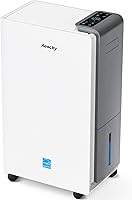
AEOCKY 80 Pint Dehumidifier: heavier loads with planned drainage
Choose the AEOCKY for a substantial moisture load with space for a compressor unit and a drain route. Compare its capacity conditions carefully if you are choosing it over a 50-pint model.
It includes humidity control, a timer, fan-speed control and power-off memory. AEOCKY backs the unit with 3-year coverage.
The included hose makes drainage planning easier, but you still need a suitable destination for the water. Higher output is most useful when collection can continue without a full bucket interrupting it.
Skip it if your decision rests only on the largest pint number. For a cooler room, check the exact operating guidance; the maximum warm-air output does not describe what it will collect there.
For alternatives across capacities and room types, see best dehumidifiers for home.
When should you choose more capacity?
Size up when humidity stays high under correct operation or the dampest season adds a clear moisture load. Choose for recurring summer conditions rather than the driest week of the year.
A laundry area used daily needs more moisture removal than an otherwise similar storage room. An open stairwell or frequently opened exterior door can also expand the workload.
Allow some headroom if your room sits near a model’s coverage limit and is persistently damp. That gives you more room for seasonal changes, though it does not guarantee shorter running time in every setting.
Do not size up merely because the bucket fills quickly. That can mean the machine is collecting water well and needs a better drainage arrangement.
Nor does frequent operation prove a fault. During the initial dry-down, furnishings and building materials can keep releasing stored moisture into the air.
After that period, judge the result by humidity trends. If readings settle near your target, the unit is doing its job even if it still runs regularly.
Can one dehumidifier handle several rooms?
One unit can serve connected spaces with good air movement, but closed doors limit its reach. A large coverage number does not mean dry air will travel evenly around corners or between floors.
For an open basement, place the machine where air can circulate through the main area. Check humidity at the far end as well as near the unit.
For separate bedrooms, decide which room actually needs moisture control. Moving one heavy machine around can be less practical than treating the problem room consistently.
A bathroom fan should still remove shower moisture at the source. Run it as intended rather than asking a hallway dehumidifier to catch all that moisture later.
If one room stays much damper than the others, investigate its airflow and water sources. Increasing capacity in another room may leave the isolated space largely unchanged.
What humidity setting should you use?
Start around 50% RH, then adjust based on room conditions and condensation. A general indoor range of 30%–50% helps guide moisture control, but room temperature and cold surfaces also matter.
Avoid turning the setting down as far as it will go to make the unit work faster. That changes the stopping target and can leave the machine running longer than you need.
Check a separate hygrometer away from the outlet. Small differences between its reading and the built-in display are less useful than the room’s overall trend.
For a basement, our guide to a good basement humidity level explains how to judge the target alongside condensation and seasonal conditions.
Water collecting on cold windows can still signal a local problem. Look at ventilation, surface temperature and moisture sources rather than relying on one room reading.
How should you set up drainage and airflow?
Set up a clear airflow path and reliable water disposal before leaving the unit to run regularly. A suitable machine cannot collect water once its full bucket shuts it down.
Use a level surface and follow the manual’s clearance requirements. Leave access to the filter and bucket so routine care does not require moving the whole machine.
For gravity drainage, the hose generally needs a continuous downhill route to a suitable drain. Avoid kinks, uphill sections and an outlet submerged in standing water.
An included hose does not establish that a model can pump water upward. If the drain sits above the outlet, confirm a suitable pumping arrangement before choosing the machine.
Check the hose during the first use to confirm that water reaches the drain without leaks. Recheck it after moving the unit or nearby stored items.
Keep exterior windows closed while dehumidifying so you are not continually treating incoming humid air. For below-ground rooms, see where to put a dehumidifier in a basement.
What care helps a dehumidifier keep up?
Keep the filter, bucket and airflow openings clean so dirt does not become a capacity problem. Follow the model’s care schedule, and inspect more often in dusty rooms.
Switch off and unplug the unit before cleaning as directed. Wash only parts the manual identifies as washable, and let them dry before reassembly.
Empty and clean the bucket even when it looks fairly clear. Collected water can leave residue, and a hose setup still needs occasional checks for buildup or blockage.
Our guide to cleaning a dehumidifier covers filters, buckets and accessible surfaces.
When storing a unit, empty it and dry the water-contact parts first. Do not leave collected water sitting through a long period of disuse.
Which sizing mistakes should you avoid?
Avoid choosing by coverage alone, confusing tank size with output, or overlooking room temperature. Those mistakes can leave you with a machine that fits the floor plan but misses the moisture problem.
Also avoid assuming that the highest fan setting increases every model’s rated capacity. Use the controls as directed, with attention to airflow, sound and humidity response.
Do not place a hygrometer directly beside the dry-air outlet and use that reading for the whole room. Check the area where dampness actually matters, such as near stored items or across the basement.
If humidity stays high, check the setting, filter, drain and airflow before replacing the machine. Then inspect for leaks, open windows, wet laundry or other continuing moisture sources.
If the unit runs but collects little water, room conditions or a fault may be responsible. Our guide to why a dehumidifier is not collecting water walks through those checks.
What size dehumidifier should you choose now?
To decide what size dehumidifier you need, choose the smallest capacity range that can handle your recurring moisture load with practical drainage. Use measured humidity to confirm the result after setup.
Pick the BEDRED for slight moisture in a small enclosed space. Choose the Cube for a modest damp room when its large bucket or storage design solves a daily inconvenience.
Move to the Midea 50 Pint for larger or persistently damp areas. Consider the AEOCKY for heavier demand after comparing removal conditions and checking the room’s temperature requirements.
Before ordering, confirm floor space, clearance and the route for collected water. Our dehumidifier size and buying guide brings the next comparisons together.
Sources
ENERGY STAR explains capacity and selection, while the EPA covers humidity control and moisture sources. Use both alongside the exact model’s operating instructions.
- ENERGY STAR: Dehumidifiers
- U.S. Environmental Protection Agency: A Brief Guide to Mold, Moisture and Your Home
Frequently asked questions
What size dehumidifier do I need for a bedroom?
Start with the bedroom’s area and measured humidity, then account for moisture from an attached bathroom or indoor laundry. A 20-pint model is worth considering for ongoing dampness in a modest room.
Choose a compact thermoelectric unit only for limited moisture, and check whether humidity actually falls.
Is a 20-pint dehumidifier enough for a basement?
A 20-pint model can suit a modest basement with a limited moisture load. Move toward a larger daily capacity when the basement is persistently damp, has several connected areas or stays above your humidity target despite correct operation.
Repair seepage or leaks separately, and plan drainage before buying.
Should I buy a larger dehumidifier than I need?
Allow some capacity for your dampest season, but avoid choosing the largest model without a reason. Extra capacity can help with a heavier moisture load, while cabinet size, sound and bucket handling still matter.
Compare units under similar capacity conditions and choose humidity controls that let you maintain your target.
What does a dehumidifier sizing chart tell me?
A sizing chart gives you a starting capacity based on floor area and dampness. It cannot fully account for room temperature, ceiling height, closed doors or ongoing water entry.
Use it to narrow the range, then check the exact model’s operating limits, drainage needs and daily capacity conditions.
How do I know if my dehumidifier is too small?
It may be too small if room humidity stays above your target through sustained operation with clear airflow and working drainage. Check the filter, settings, temperature and moisture sources first.
A full bucket shows that water is being collected; frequent emptying alone does not mean you need a larger machine.