How to Choose a Dehumidifier: Pints, Pump and Type
To choose a dehumidifier, match its capacity to room size, dampness and temperature, then plan how the water will drain. Choose a pump for an uphill drain and gravity drainage for a clear downhill route.
On this page (10 sections)
- How to choose a dehumidifier for your room
- Which dehumidifier type suits your room?
- Should you choose a bucket, gravity hose or pump?
- Which features matter in bedrooms and daily use?
- How much does it cost to run a dehumidifier?
- How should you set up a new dehumidifier?
- What care keeps a dehumidifier working well?
- Which buying and use mistakes should you avoid?
- What else should you know before choosing?
- How to choose a dehumidifier and make the final decision
To understand how to choose a dehumidifier, start with room size, dampness and temperature, then choose a drainage setup you can maintain. The right machine must remove enough moisture in your actual room and keep working without a full bucket stopping it.
Measure humidity before buying, rather than judging by smell alone. A musty odor may also point to wet materials or a leak that needs attention.
Our dehumidifier sizing guide helps you estimate capacity, while the best dehumidifiers for home guide compares options by room and use.
How to choose a dehumidifier for your room
Choose around measured humidity and the space air can move through, rather than the largest advertised coverage number. Floor area helps narrow the options, but moisture sources and closed doors change the job.
Measure the room's length and width, then multiply them for its floor area. For an open basement, include connected space; don't assume a unit in the hallway will control bedrooms behind closed doors.
Check humidity at different times over several days. Note what happens after showers, laundry, rain or opening windows, since a short spike calls for a different response than dampness that lasts all day.
Look for the source alongside the reading. Plumbing leaks, seepage and water collecting near the foundation need repairs or drainage work, even if a dehumidifier makes the air feel drier.
How do you choose dehumidifier size?
Choose capacity from area, moisture load and room temperature together. Use room-area claims as a starting filter, then compare how much water each machine removes under similar conditions.
| Room condition | Buying priority | Check before ordering |
|---|---|---|
| Mild humidity in one room | Suitable capacity and manageable noise | Humidity readings over several days |
| Recurring dampness in an open basement | Sustained removal and continuous drainage | Water sources and drain location |
| Cool garage or crawl space | Supported operating temperature | Seasonal low temperatures |
| Several separate rooms | Air circulation and individual room needs | Door positions and remote humidity readings |
| Room without a nearby drain | Convenient bucket access or a pump route | Where collected water will go |
Avoid choosing a much larger machine simply to cover rooms it cannot reach. If humidity stays high beyond a doorway, improve circulation or consider separate control for that space.
For a tailored estimate, follow our guide to what size dehumidifier you need. Our best 50 pint dehumidifiers guide helps once you've narrowed the capacity range.
What do pint ratings actually mean?
A pint-per-day figure describes water removal under stated conditions, not bucket size. A machine rated to remove many pints can have a much smaller tank because it collects and drains water throughout the day.
Compare figures measured at similar temperatures and relative humidity. A maximum figure from hot, saturated air is a poor basis for predicting collection in a cool basement.
Don't size up just because a bucket fills quickly, either. Frequent emptying can mean the machine is collecting water as intended and needs a better drainage plan.
Which dehumidifier type suits your room?
A compressor model is a practical choice for warm rooms with ongoing dampness; a desiccant model deserves a closer look in cooler spaces. Check the exact operating range before buying either type.
Compressor units cool a coil so airborne moisture condenses into water. Colder air can reduce collection, and frost on the coil can interrupt moisture removal.
Desiccant models use a moisture-absorbing material and release warmth during operation. Compare their power use and capacity at your room temperature, especially if the appliance will run for long periods.
Small thermoelectric models serve a different need: modest moisture removal in a confined space. Don't choose one for a persistently damp basement simply because its tank or coverage claim sounds large.
Does auto-defrost make a unit suitable for any cold room?
Auto-defrost helps manage frost, but it does not replace a suitable operating range. A compressor unit may spend part of its time clearing frost rather than collecting water.
Measure the room's seasonal low temperature, including overnight conditions. A garage that feels mild in the afternoon may be much colder when the unit needs to run.
Read can you use a dehumidifier in winter for seasonal guidance. Our best dehumidifiers for basements guide focuses on choices for below-ground spaces.
Should you choose a bucket, gravity hose or pump?
Choose bucket collection for easy access, gravity drainage for a downhill route and a pump for an uphill drain. Plan the full water route before comparing extra features.
A bucket works well for occasional use when you're nearby to empty it. For daily basement operation, repeated full-tank stops can leave humidity uncontrolled while you're away.
Gravity drainage needs a continuous downward slope from the outlet to the drain. A hose that crosses a doorway, loops upward or ends above the outlet can prevent proper flow.
A pump moves water upward within its limits. Maximum lift describes vertical height, so also check the approved hose length, routing and discharge instructions.
Who should choose the avylo pump model?
The avylo 90 Pint Pump Dehumidifier suits a damp space with a raised drain, particularly when frequent bucket emptying would be impractical. It combines a built-in pump with an included 15 ft hose and a specified 15 ft lift.
Its maximum removal figure is 90 pints per day at 90°F and 90% relative humidity. Use those conditions when comparing capacity, rather than assuming that output in a cooler room.
The 2.11-gallon top-mounted tank provides another collection option. avylo also identifies this model as ENERGY STAR Most Efficient 2025, a useful efficiency feature for buyers expecting regular operation.
Skip it if you only need occasional control in a small room and have no use for pumped drainage. At 38.6 lb, it also makes less sense for someone who must carry the appliance between floors often.
Empty the tank before setting up its drain connection. In gravity or pump mode, water bypasses the tank and flows through the hose, so check the discharge point rather than expecting the bucket to fill.
For other raised-drain choices, see our best dehumidifiers with a pump.
Who should choose the AEOCKY gravity-drain model?
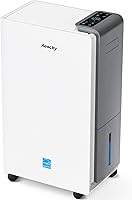
The AEOCKY 50 Pint Quiet Dehumidifier suits a bedroom, office or living area with downhill drainage. AEOCKY specifies sound around 40 dB, making it worth considering where appliance noise affects daily use.
Its removal figures are 50 pints per day at 95°F and 95% relative humidity, and 38 pints at 86°F and 80% relative humidity. Those warmer conditions matter when judging suitability for a cool basement.
It includes a 2 m drain hose and a 3/4 in GHT garden hose adapter. The 0.8-gallon tank must stay installed even when using the hose.
Choose it when you want room-to-room flexibility: it weighs 25.3 lb and has a handle and casters. AEOCKY backs the machine with a 3-year warranty.
Skip it if you need water sent uphill without adding a separate drainage solution. Bucket-only use also requires close attention during heavy moisture removal because its collection tank is relatively small.
When does a separate drain hose help?
A separate hose helps when the included hose cannot reach a suitable downhill drain. Confirm the connection first, and measure the planned route rather than the straight-line distance.
The 12 ft Drain Hose uses a 3/4 in FHT connector, rubber tubing and a nickel-plated brass fitting with a rubber seal. It suits compatible threaded gravity-drain outlets.
Choose this Ebusin hose if that connection and length solve your route. Skip it if the included hose already reaches, the outlet differs or you need a pump-specific hose.
Extra length doesn't overcome an uphill section. Keep the route as short and direct as practical, and avoid leaving unused hose coiled on the floor.
Which features matter in bedrooms and daily use?
Prioritize noise, bucket access, humidity controls and lights in occupied rooms. A feature helps only if it addresses how you'll use the appliance.
Sound figures are useful for narrowing choices, but distance, fan speed and room surfaces affect what you hear. Avoid wedging the machine against furniture or placing it where vibration can carry through a loose surface.
Check whether display lights can turn off and whether a timer fits your routine. A timer can shift operation away from quiet hours, but the room still needs enough runtime to control dampness.
Bucket access matters just as much as tank volume. Make sure you can remove a full bucket without moving the unit or lifting it over nearby furniture.
Who should buy a separate humidity meter?
A separate meter suits buyers who want to confirm the problem and check the far side of a room. It helps show whether a low reading near the appliance reflects conditions elsewhere.
The Govee H5075 Hygrometer displays temperature and humidity, records trends and supports app alerts. Govee specifies humidity accuracy of ±3% relative humidity, so don't chase every small difference between its reading and the appliance display.
The H5075 uses Bluetooth, with a maximum stated range of 164 ft in open, unobstructed conditions. It does not support Wi-Fi, so skip it if your main goal is checking conditions from outside the home.
Place it away from the dehumidifier's airflow, direct sun, windows and wet surfaces. Let the reading settle after moving it, and compare trends in the same location.
How much does it cost to run a dehumidifier?
Running cost depends on power use, runtime and your electricity rate. Compare efficiency alongside capacity, since the largest removal number does not identify the cheapest machine to operate.
To estimate daily cost, multiply power in kilowatts by hours running and your electricity rate per kilowatt-hour. Humidity control can reduce runtime once the room reaches its target.
An efficiency figure expressed in liters per kilowatt-hour shows water removal per unit of energy under its measurement conditions. Compare equivalent figures rather than brand promises about a fixed daily cost.
Our guide to how much it costs to run a dehumidifier explains the calculation. Closing exterior windows and fixing moisture sources also reduces the work the appliance must do.
How should you set up a new dehumidifier?
Set the unit on a stable, level surface with the clearances its manual requires. Give air room to enter and leave, and keep the bucket or drain connection accessible.
For a basement, choose a position with useful airflow and a safe route to the drain. Our guide on where to put a dehumidifier in a basement explains placement options.
Follow any upright settling instructions after transport. Use the electrical connection specified in the manual and keep the cord clear of wet areas and walkways.
Start around 45% to 50% relative humidity, then check the room over several days. A damp room's stored moisture can take time to dry, so judge progress by the trend rather than the first bucket.
Watch the first drainage cycle and inspect every connection. Confirm water reaches the drain, the hose stays secure and no damp patch develops under the machine.
Check again later that day and after moving or cleaning the unit. Continuous drainage reduces manual emptying, but the hose and drain still need inspection.
What care keeps a dehumidifier working well?
Keep the filter, bucket and drainage path clean, following the model's care instructions. Restricted airflow and a blocked hose can undermine an otherwise suitable choice.
Unplug the appliance before cleaning it. Check the filter more often in dusty rooms, and wash it only if the manual permits that method.
Clean the bucket even if you use a hose, since damp surfaces can collect residue. Reinstall the bucket fully so its position and safety mechanisms work as intended.
Inspect hoses for kinks, buildup and loose fittings. Don't poke tools into coils or dismantle sealed parts to reach dirt.
Our dehumidifier cleaning guide covers the filter, coils and bucket. Before seasonal storage, drain and clean the appliance, then let washable parts dry.
Which buying and use mistakes should you avoid?
Avoid choosing by coverage alone, ignoring drainage and setting humidity needlessly low. These mistakes can make a suitable machine inconvenient or leave the room damp despite long runtime.
- Confusing tank size with capacity: a larger bucket changes emptying frequency, not daily moisture-removal ability.
- Comparing unlike pint figures: check the temperature and humidity behind each number.
- Expecting whole-home reach through closed doors: measure humidity in the rooms that matter.
- Buying a gravity hose for an uphill route: choose a pump or a different drain position.
- Running beside an open window: incoming humid air adds to the moisture load.
- Setting the lowest possible humidity: aim for a useful room level instead of maximum runtime.
- Ignoring wet materials: drying the air does not repair leaks or remove damaged material.
Before ordering, write down the room area, humidity trend, lowest temperature and drain route. Then check appliance dimensions, bucket access, noise controls, filter care and warranty terms.
What else should you know before choosing?
A dehumidifier controls airborne moisture within the space it can serve. It cannot replace repairs, guarantee dry adjoining rooms or make its collected water safe to drink.
Is a bigger dehumidifier always better?
More capacity helps when moisture removal is genuinely insufficient, but it won't overcome blocked airflow or a full bucket. Check placement, drainage and the moisture source before replacing a machine with a larger one.
Can one dehumidifier handle several rooms?
One unit can help connected rooms when air moves freely between them. Check each room with a humidity meter, since a comfortable reading near the unit does not confirm control behind a closed door.
How often should you empty the bucket?
Check it often during the first few days, then base your routine on how quickly it fills. A full-tank shutoff prevents continued collection, which means moisture control pauses until you empty and replace the bucket.
Do dehumidifiers help with mold?
Lowering excess humidity helps reduce conditions that support mold growth, but it does not remove existing mold. Our guide to whether dehumidifiers help with mold explains moisture control and its limits.
Can you drink water from a dehumidifier?
Do not drink collected water, since it can pick up contaminants from the appliance and surrounding air. Read whether you can drink dehumidifier water for handling guidance.
How to choose a dehumidifier and make the final decision
Choose the avylo for a raised drain, or the AEOCKY for an occupied room with gravity drainage. Compare their removal figures against your room's temperature before deciding which capacity fits.
Add the Ebusin hose only if its connection and reach solve a drainage problem. Choose the Govee meter if you need room-level trends and Bluetooth access meets your needs.
Your final check is practical: can the machine operate at the room's temperature, move water to a suitable drain and maintain humidity where you need it? Use our best dehumidifiers for home guide to compare alternatives once those requirements are clear.
Frequently asked questions
How do I choose the right size dehumidifier?
Choose capacity using room area, humidity and temperature together. Measure the space, check humidity over several days and compare water-removal figures measured under similar conditions.
A damp basement can need more capacity than a mildly humid room of equal size, while closed doors can limit coverage.
Is a pump dehumidifier better than a hose?
Choose a pump when water must travel uphill; choose gravity drainage when the hose can slope downhill throughout its route. A pump adds a way to move water, not extra moisture-removal capacity.
Check the approved hose, maximum lift and discharge location before choosing your setup.
Should I choose a compressor or desiccant dehumidifier?
Choose a compressor model for a warm room with a substantial moisture load, and compare desiccant models for cooler spaces. The exact operating range matters more than the type alone.
Check capacity at relevant temperatures, power use and drainage before deciding which model suits your room.
What humidity should I set on a dehumidifier?
Start around 45% to 50% relative humidity, then adjust for comfort and persistent condensation. Use a separate meter away from the appliance to check the room rather than chasing small changes on its display.
A lower setting can extend runtime without solving a leak or cold surface.
Do I need a separate hygrometer?
A separate hygrometer is useful for confirming dampness before buying and checking humidity away from the dehumidifier afterward. Place it away from direct airflow, windows and wet surfaces, then follow the trend over several days.
Small differences between meters do not necessarily mean either device has failed.