6 Best Dehumidifiers for Crawl Spaces (October 2026)
The best dehumidifiers for crawl spaces include the Waykar 70 Pint Crawl Space Dehumidifier for flexible drainage, the ALORAIR 113 Pint Crawl Space Dehumidifier for downhill drainage, and the ALORAIR 70 Pint Pump Crawl Space Dehumidifier for raised drain outlets.
On this page (8 sections)
- Which is the best dehumidifier for your crawl space?
- How do you size a crawl space dehumidifier correctly?
- Should you use a pump or gravity drainage?
- Where should you place a crawl space dehumidifier?
- What humidity setting should you use after installation?
- How do you care for a crawl space dehumidifier?
- Which crawl space dehumidifier mistakes should you avoid?
- Which model should you choose for your crawl space?
The Waykar 70 Pint Crawl Space Dehumidifier is the best dehumidifier for crawl space use for most buyers here because it offers pump and gravity drainage. Choose the larger Waykar for a heavier moisture load, or the ALORAIR HD35P when a raised outlet makes pump lift your main concern.
Clearance, drainage and moisture load matter more than the largest number on the box. A unit must fit through the hatch, circulate air beyond its immediate corner and send collected water somewhere it won't return.
Our guide to dehumidifiers for basements and crawl spaces covers the wider moisture-control plan. If you're deciding between a crawl space machine and a household model, start with our best dehumidifiers for home guide.
Our picks at a glance
-
1
 Best for flexible drainage
Waykar 70 Pint Crawl Space Dehumidifier
7.9/10 our score
See it on Amazon -
2
 Best for downhill drainage
ALORAIR 113 Pint Crawl Space Dehumidifier
7.6/10 our score
See it on Amazon -
3
 Best for raised drain outlets
ALORAIR 70 Pint Pump Crawl Space Dehumidifier
7.1/10 our score
See it on Amazon
- 4
 Check it
Waykar 125 Pint Crawl Space Dehumidifier
Best for large crawl spaces - 5
 Check it
Aiusevo 70 Pint Crawl Space Dehumidifier
Best for accessible control panels - 6
 Check it
BaseAire 70 PPD Crawl Space Dehumidifier
Best for low clearance
Which is the best dehumidifier for your crawl space?
Choose the Waykar 70 Pint for a flexible everyday installation, then move to another pick when your drain height, access or moisture load calls for it. We compared drainage, removal conditions, dimensions and service access because those details decide whether a crawl space unit is practical.
1. Waykar 70 Pint Crawl Space Dehumidifier
Waykar 70 Pint Crawl Space Dehumidifier
- 70 pints per day at 95°F and 90% RH
- Built-in pump and gravity drainage
- Washable filter
- Metal casing
A built-in pump and separate gravity connection give you options for routing water out of a crawl space. Waykar identifies this model as ENERGY STAR certified.
Pros
- Includes pump and gravity hoses
- Adjustable feet
- Automatic restart and defrost
Cons
- Remote control costs extra
- Warm-condition capacity is not an AHAM figure
The Waykar is the first choice for buyers who want two workable drainage options without arranging a separate pump. It includes a 16.4 ft pump hose, supports lift up to that height and comes with a 6.6 ft gravity hose.
Its removal rate is up to 70 pints per day at 95°F and 90% relative humidity. Waykar rates coverage up to 5,000 sq ft, but that area claim isn't a promise for a cold crawl space or one with ongoing water entry.
Waykar identifies this model as ENERGY STAR certified, a useful consideration for regular operation. A washable filter and service reminder also suit a machine that may spend long periods out of sight.
The body measures 15.79 x 13.58 x 13.15 in, before allowing room for hoses, airflow and filter removal. Adjustable feet help you establish a stable position on a suitable base.
Buy it for a drain route that needs flexibility, especially if your final placement could change during installation. An optional remote lets you adjust settings without reaching the main panel.
Skip it if the required lift exceeds its limit or the body leaves no room to service it. A compact unit that you can maintain is a better choice than one wedged beneath plumbing.
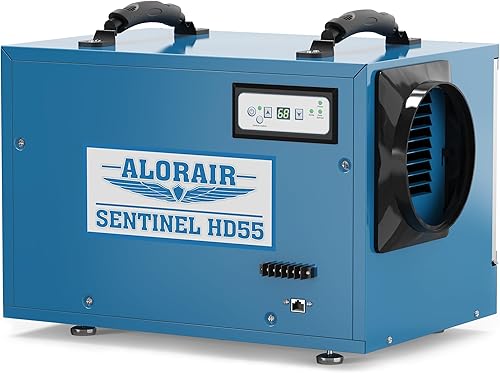
2. ALORAIR 113 Pint Crawl Space Dehumidifier
ALORAIR 113 Pint Crawl Space Dehumidifier
- 53 pints per day at AHAM
- 113 pints per day at saturation
- Automatic defrost
- No internal tank
The Sentinel HD55 suits a crawl space with a dependable downhill drain route. Its separate AHAM and saturation figures make capacity comparisons clearer.
Pros
- AHAM removal capacity provided
- Metal casing
- Optional remote control
Cons
- Needs a continuous drain route
- Built-in pump is not specified for this model
The Sentinel HD55 suits buyers with a dependable downhill drain route who want a clear AHAM removal figure. It removes 53 pints per day at AHAM conditions, compared with 113 pints per day at saturation.
Those figures describe the same machine under different conditions. Don't read its name as proof that it removes more water in your crawl space than every model with a smaller headline number.
ALORAIR rates it for up to 1,200 sq ft, and its tank-free design sends water through continuous drainage. Plan that connection before delivery because bucket collection isn't an alternative.
The metal body measures 19.2 x 12.2 x 13.3 in and weighs 41.7 lb. Its extra length matters when you need to turn the machine through a hatch or position it between obstacles.
Automatic defrost helps manage frost on the coils, while the MERV-1 filter protects internal parts from dust. An optional remote control can make a hard-to-reach installation easier to manage.
Choose it for an installation with an established drain below the unit. Skip it when the route requires upward pumping and you want that function built into the machine you buy.
3. ALORAIR 70 Pint Pump Crawl Space Dehumidifier
ALORAIR 70 Pint Pump Crawl Space Dehumidifier
- 35 pints per day at AHAM
- Built-in condensate pump
- Automatic restart
- Automatic defrost
The Sentinel HD35P is the clearest choice here when a raised outlet makes pump lift the deciding factor. Its compact body also helps with low access openings.
Pros
- Includes a 19.6 ft pump hose
- Compact body
- Automatic restart after power interruptions
Cons
- Lower AHAM capacity than the HD55
- Limited to ALORAIR's claimed 1,000 sq ft coverage
The Sentinel HD35P is the strongest fit here for a smaller crawl space with a raised drain outlet. Its built-in pump supports up to 19.6 ft of vertical lift, and ALORAIR includes a hose of the same length.
Removal capacity is 35 pints per day at AHAM conditions and 70 pints per day at saturation. ALORAIR rates coverage up to 1,000 sq ft, so choose it for the drainage problem it solves rather than its headline pint figure.
At 15.2 x 11.2 x 11.4 in, it shares the smallest stated body dimensions in this group with the BaseAire. Its 38.2 lb weight still calls for a clear handling plan around a narrow hatch.
Automatic restart resumes operation after a power interruption, and automatic defrost manages frost buildup. Check the drain after an outage too, since resumed operation won't clear a blocked or frozen hose.
Choose it when pump lift and low clearance both matter. Skip it if the crawl space has a larger moisture load than its AHAM capacity can handle, even when the machine physically fits.
Measure the complete hose route before buying. The maximum vertical lift doesn't mean you can add unlimited horizontal distance or extra bends.
4. Waykar 125 Pint Crawl Space Dehumidifier
Waykar 125 Pint Crawl Space Dehumidifier
- 125 pints per day at 95°F and 90% RH
- Pump and gravity drainage
- Supports 5.9 in exhaust piping
- Washable filter
This Waykar offers more warm-condition removal capacity for a larger moisture load. Exhaust piping support adds an installation option for layouts that need directed airflow.
Pros
- Highest stated warm-condition removal figure here
- Includes both drain hoses
- Optional remote control
Cons
- 49.8 lb body complicates access
- Extra capacity may be unnecessary in a small sealed space
The larger Waykar suits a large crawl space with substantial ongoing humidity after water-entry repairs. Its stated removal rate reaches 125 pints per day at 95°F and 90% relative humidity, with Waykar rating coverage up to 6,500 sq ft.
Its capacity is measured under the same conditions as the smaller Waykar's figure, making that comparison useful. Expect less water collection as the space becomes cooler or drier.
The included pump hose is 16.4 ft long, with vertical lift up to that height, and a separate 6.6 ft hose supports gravity drainage. Support for 5.9 in exhaust piping adds an option for directing discharge air.
A duct connection needs planning around airflow and the manufacturer's instructions. It doesn't turn a blocked or divided crawl space into one open room.
The body measures 19.29 x 12.6 x 13.58 in and weighs 49.8 lb. Allow for safe handling, a suitable support surface and enough room to reach the filter and connections.
Buy it when the moisture load justifies the added capacity and handling effort. Skip it for a small, mildly damp sealed space where a smaller unit fits better and can maintain the humidity target.
5. Aiusevo 70 Pint Crawl Space Dehumidifier
Aiusevo 70 Pint Crawl Space Dehumidifier
- Touchscreen humidity control
- Timer and temperature display
- Pump and gravity drainage
- Automatic restart and defrost
The touchscreen combines humidity adjustment, a timer and a temperature display for a unit you can reach easily. Error codes help identify sensor or overload faults.
Pros
- Temperature display and error codes
- Washable filter
- Includes pump and gravity hoses
Cons
- Conflicting dimensions need confirmation
- Remote operation requires a compatible wired control
The Aiusevo suits buyers who can reach the unit and want humidity, timer and temperature controls together. Its touchscreen also displays error codes for issues such as sensor faults or overload.
Removal reaches 70 pints per day at 95°F and 90% relative humidity, with Aiusevo rating coverage up to 4,000 sq ft. Those conditions match the smaller Waykar's removal figure, while the brands' area claims differ.
Pump and gravity drainage are available, with a 16.4 ft pump hose and a 6.6 ft gravity hose included. Don't assume pump hose length establishes the allowed vertical lift; confirm that limit for your route.
Automatic restart, automatic defrost and a washable filter cover useful routine needs. A compatible wired remote provides another way to operate it, provided you plan the cable route.
Choose it when the panel will remain accessible and the control features fit how you'll manage the space. Skip it for a close-fitting hatch until Aiusevo confirms the body dimensions, which differ across its specifications.
For suspension, confirm the required hardware and support method before installation. A carry handle is for moving the unit, not a substitute for an approved mounting system.
6. BaseAire 70 PPD Crawl Space Dehumidifier
BaseAire 70 PPD Crawl Space Dehumidifier
- 15.2 x 11.2 x 11.4 in body
- Automatic humidity control
- Built-in pump
- Automatic defrost
The AirWerx 35P fits low spaces and offers an optional suspension hanger. Resolve its conflicting capacity and coverage figures before relying on it for a specific moisture load.
Pros
- Compact body with adjustable feet
- Optional suspension installation
- Automatic humidity control
Cons
- Capacity and coverage figures conflict
- Pump lift and hose requirements need confirmation
The AirWerx 35P is worth considering when low clearance limits your options, provided you resolve its sizing details first. Its body measures 15.2 x 11.2 x 11.4 in, matching the compact ALORAIR pump model.
It weighs 38.2 lb and has adjustable feet for floor placement. BaseAire also offers an optional hanger for suspension, which can help when a suitable installation needs to preserve floor space.
Automatic humidity control starts and stops operation around the selected setting. Automatic defrost and a built-in pump add functions suited to an unattended crawl space installation.
The main buying drawback is unclear sizing information. BaseAire provides conflicting removal and coverage figures, so get confirmation of the AirWerx 35P's capacity conditions, supported area, pump lift and hose requirements before ordering.
Choose it only when its compact shape solves an access problem and those details are settled. Skip it if you need to select a machine immediately from clear drainage and removal specifications.
During setup, match the hose connection to the selected drainage mode. BaseAire requires pump mode and its pump outlet for pumped drainage, while gravity operation uses its separate connection with pump mode off.
How do you size a crawl space dehumidifier correctly?
Size for moisture load and operating conditions, then use floor area as a screening tool. An area rating can't account for wet soil, air leaks, cool temperatures or separate sections with poor airflow.
Compare crawl space dehumidifier capacity under matching conditions
AHAM and saturation figures aren't interchangeable. A machine can collect much more water from hot, very humid air than from cooler air near your target humidity.
The ALORAIR models provide both figures, showing how large that difference can be. The Waykar models use 95°F and 90% RH for their stated removal rates, so compare those two directly rather than mixing measurement conditions.
Don't assume a larger coverage claim means stronger removal in your home. Our dehumidifier size guide explains how room conditions affect the capacity you need.
Separate airborne humidity from water entry
Stop liquid water at its source before asking a dehumidifier to control the air. Plumbing leaks, recurring seepage and puddles need repair or drainage work.
Exposed damp soil can also keep feeding moisture into a crawl space. Ground-cover and sealing work may reduce that load, but the right approach depends on the home's drainage, construction and climate.
Persistent condensation near a cold pipe may need attention to that surface as well as room humidity. More removal capacity won't correct every cause of local dampness.
Account for walls and divided sections
A dehumidifier needs air to reach it. Foundation walls, isolated bays and stored materials can leave one section damp while the area around the machine dries.
Check humidity in more than one location before assuming one unit serves the whole footprint. A divided layout may need a planned air path, suitable ducting or another placement approach.
Should you use a pump or gravity drainage?
Use gravity when the entire hose route can run downhill; choose a pump when water must rise. Decide the route before choosing the machine, since drainage can rule out an otherwise suitable model.
Gravity drainage has fewer moving parts, but it needs a continuous fall to a suitable destination. A sag, uphill loop or crushed section can hold water and interrupt flow.
With a pump, measure the vertical rise separately from the total hose distance. Follow the model's limits for hose size, routing and extensions rather than treating maximum lift as a complete installation allowance.
Secure the hose where it could shift or get pinched, and keep its end clear. Discharge should carry water away from the foundation instead of soaking nearby ground that can feed moisture back inside.
If your route requires upward drainage, our best dehumidifiers with a pump guide offers more options. For any model, confirm the permitted discharge arrangement before drilling an outlet or connecting to plumbing.
A pump also needs inspection. Check that it actually moves collected water after installation, rather than assuming the sound of the dehumidifier means drainage is working.
Where should you place a crawl space dehumidifier?
Place it on a stable support with clear airflow and reachable service points. The easiest empty corner is useful only if air can circulate there and the drain route works.
Measure the hatch and every turn between it and the final position. Body dimensions alone don't allow for handles, connected hoses, wiring or the space needed to move the unit into place.
Keep the unit out of standing water and off soft ground that can settle. Use a suitable level base or the manufacturer's approved suspension method, with structural support appropriate for the load.
Leave the specified space around the inlet and outlet. Also check whether you can remove the filter, inspect hose joints and read the controls without moving the whole machine.
Follow the manual for power requirements and use an appropriate outlet. Don't route cords through wet areas or rely on a temporary extension arrangement for permanent operation.
Our guide to where to put a dehumidifier in a basement explains airflow and access principles that also apply below a low floor. In a crawl space, add a practical question: can you still reach it after the installation is complete?
What humidity setting should you use after installation?
Start around 50% relative humidity and check conditions away from the machine. Set a practical target rather than choosing the lowest number the controls allow.
Use a separate hygrometer in a representative area, away from the dry outlet air. Check another section if walls or narrow passages divide the crawl space.
After startup, look for a downward trend over several days rather than an instant change everywhere. Damp building materials can continue releasing moisture after the air around the unit begins to dry.
If the machine reaches its target but another section stays humid, check airflow and sensor placement. Lowering the setting may only make the nearby area drier while the remote section remains damp.
If humidity stays high everywhere, inspect the drain, filter, airflow and water sources before replacing the unit. A blocked hose or new leak can resemble a capacity problem.
How do you care for a crawl space dehumidifier?
Inspect the filter, drainage and surrounding area regularly, even when humidity control is automatic. Check soon after installation, then set a care schedule based on the manual and how dusty or damp the space gets.
Disconnect power before maintenance as directed by the manufacturer. Clean washable filters as instructed, let them dry properly and replace filters that require replacement rather than washing.
Look along the full drain route for kinks, loose joints, sludge and signs of leakage. Inspect the discharge point too, especially after yard work, freezing weather or movement around the hose.
Keep the inlet and outlet free of stored items, insulation and debris. Our dehumidifier cleaning guide explains routine filter and accessible-surface care.
Recheck humidity after a power interruption or a change in weather. Automatic restart is useful, but it doesn't confirm that the hose remains clear or that the target setting still suits conditions.
Before cold weather, verify the allowed operating temperature and protect the drain from freezing. Defrost manages frost inside the machine; it doesn't protect an exposed discharge hose.
Which crawl space dehumidifier mistakes should you avoid?
Avoid buying around one headline number or leaving installation details until delivery. Most poor matches start with a capacity assumption, an access problem or an unfinished drain route.
- Buying by area alone: match capacity conditions and moisture load, especially in a cool or persistently damp space.
- Treating hose length as pump lift: check each limit separately, including permitted extensions and routing.
- Blocking filter access: leave enough room for regular care without disconnecting the entire installation.
- Using a remote as a substitute for inspection: remote controls can change settings, but they can't reveal a leaking joint or obstructed outlet.
- Running against an open moisture source: repair leaks and address ground moisture instead of expecting endless operation to solve them.
- Assuming metal means weatherproof: a rugged casing doesn't make a unit suitable for immersion or exposure beyond its instructions.
Don't use the amount of water collected as your only success measure. Less collection can mean the crawl space is drier, so judge results by humidity trends, drainage and the condition of the space.
Which model should you choose for your crawl space?
Choose by the installation problem you need to solve. The best dehumidifier for crawl space use is the one that fits, drains reliably and can maintain humidity throughout the space.
Pick the Waykar 70 Pint for flexible pump or gravity drainage. Choose the ALORAIR HD55 when you have a dependable downhill route and want its higher AHAM capacity compared with the smaller ALORAIR.
Choose the ALORAIR HD35P for a raised outlet in a smaller space, or the Waykar 125 Pint when a larger moisture load justifies the capacity. Consider Aiusevo for reachable controls and BaseAire for low clearance after resolving their noted installation questions.
Before ordering, write down the hatch size, service clearance, drain distance and vertical rise. Those measurements turn a shortlist into a choice you can actually install.
If mold is part of the problem, lowering humidity supports moisture control but doesn't remove existing growth or repair damaged materials. Read whether dehumidifiers help with mold to plan that next step.
Our top 3 picks at a glance
-
1
Best for flexible drainage
Waykar 70 Pint Crawl Space Dehumidifier
7.9/10 our score
See it on Amazon -
2
Best for downhill drainage
ALORAIR 113 Pint Crawl Space Dehumidifier
7.6/10 our score
See it on Amazon -
3
Best for raised drain outlets
ALORAIR 70 Pint Pump Crawl Space Dehumidifier
7.1/10 our score
See it on Amazon
Frequently asked questions
What size dehumidifier do I need for a crawl space?
Choose capacity from the crawl space's area, moisture load and temperature, then compare removal figures measured under matching conditions. A sealed space with mild dampness needs a different approach from wet soil or recurring seepage, so correct water entry before expecting a dehumidifier to maintain your target humidity.
Should a crawl space dehumidifier have a pump?
Choose a pump when water must rise above the unit to reach a suitable drain, and check both vertical lift and hose distance. Gravity drainage is simpler when the entire route can slope downward, but either method needs a secure hose and a discharge point that won't wet the foundation.
Where should a crawl space dehumidifier drain?
Drain it to a suitable drain or permitted discharge point that carries water away from the foundation, following the manual and local requirements. Keep the hose secure and accessible for inspection, and avoid discharging onto crawl space soil, where the collected water can return to the air.
What humidity should a crawl space stay at?
Start around 50% relative humidity and use a separate hygrometer to check areas away from the unit. If those areas remain damp while the machine reaches its setting, look for blocked airflow, leaks or exposed wet soil before lowering the target and making the unit run longer.
Can a crawl space dehumidifier run in cold weather?
Yes, if crawl space temperatures remain within the model's allowed operating range; automatic defrost does not establish that range. Check the manual before winter use and protect the drain route from freezing, with more seasonal advice in our guide to using a dehumidifier in winter.