AEOCKY Dehumidifier Review: Worth It? (October 2026)
The AEOCKY dehumidifier suits large, damp rooms with a nearby drain, especially where automatic restart after a power outage matters. Choose it for ongoing humidity control, but confirm its operating temperature range before buying for a cold basement.
On this page (10 sections)
- The AEOCKY dehumidifier at a glance
- What does the 80-pint rating mean?
- Will one unit cover your whole basement?
- How does AEOCKY compare with KNKA and Waykar?
- Does the AEOCKY work in a cool basement?
- How should you set up drainage and the first run?
- What humidity setting should you use?
- How loud is it, and what will it cost to run?
- What care prevents avoidable problems?
- Which AEOCKY dehumidifier buyer should choose an alternative?
The AEOCKY dehumidifier is a good fit for a large, damp room with access to a drain, especially if you want it to resume its function after a power outage. Choose it for ongoing moisture control rather than occasional bucket duty.
The RHEA-001 combines a compressor, adjustable humidity control and several operating modes. Its strongest buying case is a basement where you can give it clear airflow, route the hose safely and let the humidity control manage normal operation.
Skip it if your main need is a large water bucket or a unit for a very cold space without first confirming the temperature limits. The room, drain and daily routine matter more than the largest number on the box.
The AEOCKY dehumidifier at a glance
The AEOCKY RHEA-001 favors ongoing humidity control over infrequent manual emptying. Its included drain hose and garden hose adapter make it worth considering when a suitable drain is nearby.
AEOCKY 80 Pint Dehumidifier

- 80 pints per day at 95°F and 95% RH
- Power-off memory
- 1.45-gallon tank
- Drain hose and garden hose adapter included
A strong fit for ongoing basement humidity control when you can route water to a drain. Power-off memory resumes its function after electricity returns.
Pros
- Drain hose and garden hose adapter included
- Resumes function after power returns
- Sleep and continuous modes
- AEOCKY provides 3-year coverage
Cons
- Frequent tank emptying at high moisture loads
- Confirm the minimum operating temperature for cold rooms
It measures 14.45 in deep x 8.66 in wide x 24.09 in high and weighs 31 lb. Measure the space around it as well as its footprint, since the air intake, outlet and tank need room.
The controls include auto, constant humidity, continuous, smart drying and sleep modes, along with fan speed control, a timer and a child lock. AEOCKY provides 3-year coverage, so keep the receipt and coverage terms with the manual.
Who should buy the AEOCKY dehumidifier?
Buy it for a damp basement or large connected room where moisture returns throughout the humid season. Power-off memory is useful when an outage would otherwise leave the room without humidity control until someone notices.
Choose a different setup if water must drain uphill or several closed rooms need separate control. A portable unit needs a workable water route and an air path to the spaces you're trying to dry.
What does the 80-pint rating mean?
The 80-pint capacity is a daily removal rate under warm, very humid conditions, not the amount the bucket holds. AEOCKY specifies that rate at 95°F and 95% relative humidity, with 56 pints per day at 86°F and 80% relative humidity.
A cooler basement will usually yield less water than those warm conditions. Lower collection can also be normal once the room reaches your humidity target, so a partly filled bucket isn't automatically a problem.
The internal tank holds 1.45 gallons, or 11.6 pints. At sustained high output, that means several emptying trips per day unless you connect the hose.
Compare capacity figures only when the temperature and humidity conditions match. Our dehumidifier size guide explains how room area and dampness affect the capacity you need.
Will one unit cover your whole basement?
An open basement is a better fit than a home divided into closed rooms, even when both have the same floor area. AEOCKY claims coverage up to 5,500 sq ft, but doors, partitions and moisture sources change the job.
Start by identifying the wettest areas and the source of the moisture. A dehumidifier can remove water vapor, but plumbing leaks, seepage and rain entering through gaps need repair.
Put a separate hygrometer in the area you care about, away from the dry-air outlet. If the room near the machine dries while a distant room stays damp, improve the air path or consider separate control for that space.
Leave clearance around the unit according to the manual and keep stored boxes away from the intake. Our guide to where to put a dehumidifier in a basement helps you balance airflow, drainage and access.
How does AEOCKY compare with KNKA and Waykar?
Choose between these models by drainage, controls and room layout, since their maximum capacity figures don't settle the choice. Waykar's capacity uses different humidity conditions from the other two, so the shared 80-pint label doesn't establish equal output.
| Model | Buyer priority | Main trade-off |
|---|---|---|
| AEOCKY | Ongoing basement use with automatic restart | Plan the drain route before choosing its location |
| KNKA | Visible humidity controls in an occupied room | Its larger external tank costs extra |
| Waykar | Spreading dry air across an open room | Smaller bucket makes manual emptying less convenient |
KNKA: choose it for a shared living area
KNKA suits a room where you want to see humidity at a glance, then turn off the display and indicator lights at night. It also has casters, cord storage and a washable filter for routine moving and care.
KNKA 80 Pint Dehumidifier

- 80 pints per day at 95°F and 95% RH
- Humidity display with switchable lights
- 1.45-gallon tank
- Washable filter
Choose KNKA for a living area where you want a visible humidity reading by day and dark controls at night. Its optional larger external tank is a separate purchase.
Pros
- Humidity display and indicator lights can be turned off
- Drain hose included
- Washable, reusable filter
- Auto, dry and adjustable humidity modes
Cons
- External tank is sold separately
- Inlet humidity reading can differ from a room hygrometer
Its AUTO mode defaults to 50% relative humidity, while SETTING mode lets you choose from 30% to 80%. DRY mode gives you a separate option for clothes drying, though indoor laundry still adds moisture that the unit must remove.
The included drain hose is 6.56 ft long, and an optional 2.64-gallon external tank is sold separately. Skip KNKA if you're choosing it only to avoid emptying water, since the standard bucket is the same size as AEOCKY's.
KNKA measures humidity at the air inlet, so a separate hygrometer elsewhere may show a different number. Compare readings after conditions have settled rather than changing the setting after every small difference.
Waykar: choose it for an open room
Waykar suits an open space where its 90-degree auto swing can spread the outgoing dry air. It also offers a 24-hour timer and automatic defrost.
Waykar 80 Pint 5,000 Sq Ft Dehumidifier
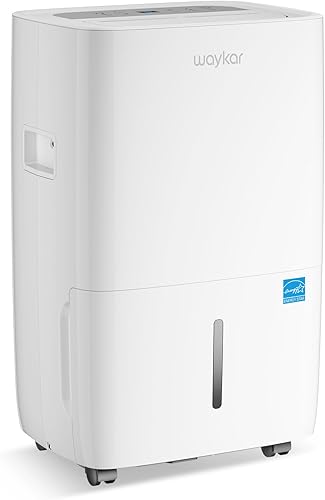
- 80 pints per day at 95°F and 90% RH
- 90-degree auto swing
- 30%–80% humidity control
- Manual or continuous drainage
Choose Waykar for an open room where its swinging outlet can spread dry air. Plan on hose drainage if frequent bucket emptying would interrupt your day.
Pros
- Adjustable humidity from 30% to 80%
- 90-degree auto swing
- Standard 3/4-inch garden hose connection
- Automatic defrost
Cons
- Smaller bucket than the other models here
- Included hose length needs confirmation before planning placement
Its 1.14-gallon bucket is the smallest here, making hose drainage the better fit for long daily runs. A standard 3/4-inch garden hose connection gives you another drainage option without an extra adapter.
Waykar's included hose length is described inconsistently, so confirm the supplied length before planning a distant drain route. Skip it if fewer bucket trips are your main goal or you're expecting the swinging outlet to dry closed rooms.
Read Midea Cube vs AEOCKY dehumidifiers for a different design comparison, or our Waykar 80 Pint Dehumidifier review for more on that alternative.
Does the AEOCKY work in a cool basement?
Confirm the operating temperature range before buying for a cold basement. AEOCKY describes low-temperature operation and defrost sensors, but its reference to 65°F does not establish a minimum operating temperature.
Compressor dehumidifiers can develop frost on their coils in cool air. A defrost cycle manages that frost, but time spent defrosting can reduce the water collected over a day.
Measure the basement temperature during its coldest normal conditions, not just on a warm afternoon. Compare that measurement with the manual's limits before deciding that a portable compressor model suits year-round use.
Our guide to using a dehumidifier in winter explains how colder air changes the job.
How should you set up drainage and the first run?
Choose the location and water route before switching the unit on. A convenient outlet alone isn't enough if the hose must cross a walkway or climb to a sink.
Keep a compressor dehumidifier upright and follow its manual's settling instructions after transport. KNKA specifically calls for 24 hours upright before first use; don't assume every model has the same requirement.
For gravity drainage, use a secure connection and a hose that slopes down to the drain without kinks, raised loops or a submerged end. A drain above the outlet needs a pump arrangement rather than a longer gravity hose.
Check the connection and the area beneath it during the first run. Recheck after moving the machine, because a pulled or pinched hose can interrupt drainage.
If you use the bucket, make emptying it part of your routine and seat it fully after replacement. Don't plan long unattended runs until you understand how quickly the room fills it.
Close exterior doors and windows while drying the space. Leaving them open can keep bringing in humid air and extend the run time.
What humidity setting should you use?
Start around 50% relative humidity, then adjust based on a separate room reading and the conditions you're trying to control. A normal household target often falls within 30%–50%, so the lowest available setting isn't the default goal.
Use a humidity-controlled mode for routine room care. Continuous operation makes more sense for a specific drying job with reliable drainage and regular checks than for leaving a living space as dry as possible.
Give the room time to respond before changing settings repeatedly. Walls, furnishings and stored materials can release moisture after the air near the unit begins to dry.
Don't judge performance only by bucket volume. If the humidity stays near your target and condensation decreases, collecting less water can mean the moisture load has fallen.
If humidity remains high and little water appears, check temperature, airflow, mode and drainage. Our guide to why a dehumidifier may not collect water walks through common causes.
How loud is it, and what will it cost to run?
Plan for compressor and fan noise in an occupied room, even with a sleep mode. AEOCKY states 44 dB at its lowest fan speed, while KNKA gives 40–45 dB and Waykar gives about 42 dB.
Those figures don't establish a reliable quietness ranking because the measurement conditions aren't supplied here. If you're sensitive to sound, placement away from the bed or desk matters as much as the stated number.
Use a firm, level surface and keep the cabinet from touching nearby objects that might vibrate. Follow the required clearances rather than enclosing the machine to hide its sound.
AEOCKY identifies the RHEA-001 as ENERGY STAR Most Efficient 2025. That designation concerns efficiency; it doesn't predict your electricity bill or guarantee a particular saving against another model.
Run time, incoming moisture and your electricity rate determine the expense. Use our guide to how much it costs to run a dehumidifier to work out an estimate for your schedule.
What care prevents avoidable problems?
Keep the air path, bucket and drain hose clean so dust and standing water don't undermine daily use. Follow the manual's cleaning schedule, checking more often in dusty spaces.
Switch off and unplug the unit before routine cleaning. Clean the filter as directed, and only wash a filter when the instructions permit it.
KNKA and Waykar have washable filters; let a washed filter dry fully before reinstalling it. Avoid spraying cleaner or water into the cabinet.
Wash and rinse the bucket regularly, even if you normally use a hose. Inspect the hose for buildup, bends and loose connections, and dry the bucket before seasonal storage.
Our dehumidifier cleaning guide covers filter, coil and bucket care. Keep cleaning separate from internal repairs, which should follow the service instructions.
Which AEOCKY dehumidifier buyer should choose an alternative?
Choose the AEOCKY dehumidifier when you have a damp, connected space, a practical drain route and a need for automatic restart. Confirm the room temperature first, then plan placement before ordering.
Pick KNKA for an occupied room where switchable display lights and easy humidity checks fit your routine. Choose Waykar for an open room where a swinging outlet is useful and you can avoid frequent bucket emptying with a hose.
If your space is small, divided into separate rooms or lacks a suitable drain, reconsider the size and design before buying any of these. Our home dehumidifier size-and-room guide helps you choose around those limits.
Frequently asked questions
How large a room can the AEOCKY dehumidifier cover?
AEOCKY claims coverage up to 5,500 sq ft for the RHEA-001, but layout and moisture load should guide your choice. An open basement allows easier air circulation than several closed rooms.
Measure humidity in the spaces you need to dry rather than assuming one central unit will reach them all.
Does the AEOCKY dehumidifier have a drain hose?
Yes, the AEOCKY dehumidifier includes a drain hose and garden hose adapter, plus a 1.45-gallon internal tank. Plan a downhill route to a suitable drain for gravity drainage.
If water must travel uphill, choose a separate pump arrangement or a model with a built-in pump.
Can the AEOCKY dehumidifier run in a cold basement?
AEOCKY describes low-temperature operation and defrost sensors, but confirm the minimum operating temperature in the manual before buying for a cold basement. The brand's reference to 65°F is not a stated lower limit.
Defrost helps manage frost; it does not make moisture removal independent of room temperature.
How does AEOCKY compare with KNKA and Waykar?
Choose AEOCKY for power-off memory and ongoing humidity control near a drain. KNKA suits shared living spaces with its switchable humidity display and lights, while Waykar suits open rooms where auto swing can distribute dry air.
Decide on drainage and placement before using maximum capacity as the deciding factor.


