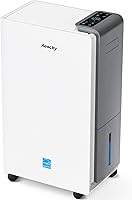
Midea Cube 50 Pint Dehumidifier Review: Worth It? (October 2026)
Our Midea Cube 50 pint dehumidifier review favors it for fewer bucket trips in a mostly stationary setup. Choose it for the large tank and nested storage, provided you can manage the bucket or arrange continuous drainage.
On this page (10 sections)
- Midea Cube 50 pint dehumidifier review: the main trade-off
- What does the lift-and-twist design change?
- How does the Cube compare with the conventional Midea?
- How much room can the Cube handle?
- Should you use the bucket or continuous drainage?
- How should you set up the Cube?
- Are the smart controls useful?
- Which alternative fits a different routine?
- What care and use mistakes should you avoid?
- Midea Cube 50 pint dehumidifier review: the buying decision
The Midea Cube is a good fit for fewer bucket trips, especially in a damp room where it can stay in place. This Midea Cube 50 pint dehumidifier review centers on the choice that matters most: whether its large tank makes your routine easier.
The design suits a basement you check daily but don't want to visit repeatedly to empty water. It makes less sense if you need frequent stair carries or would struggle to lift a large bucket.
Midea Cube 50 pint dehumidifier review: the main trade-off
The Cube trades a familiar upright shape for more water storage and a nested form. Its main advantage is how you collect water and put the appliance away, rather than a higher moisture-removal capacity than the conventional Midea.
Midea Cube 50 Pint Dehumidifier

- 50 pints per day
- 4.2 gallon tank
- Wi-Fi and voice control
- Nested storage form
Choose the Cube for a mostly stationary damp room where a larger bucket saves trips. Its nested form also helps when you need to store it between damp seasons.
Pros
- Large removable tank
- Drain hose included
- SmartHome app and voice control
- Nested form for storage
Cons
- Heavy to carry between floors
- A full bucket can be difficult to lift
- Extended setup needs clearance
The Cube removes up to 50 pints per day and has a 4.2 gallon removable tank. Daily removal capacity describes water extracted under particular conditions; tank volume describes how much water it can hold before emptying.
Those figures answer different questions. A larger bucket extends the time between trips at the same collection rate, but it doesn't make the air dry faster.
Who should buy the Midea Cube 50 pint dehumidifier?
Buy the Cube if manual emptying is your main inconvenience and you have room to access the bucket. It also suits seasonal use when you want to store the appliance after the damp period ends.
Skip it if carrying water is already difficult. You can empty the bucket early, but doing so gives up part of the reason to choose this design.
A permanent drain changes the decision, too. Once water leaves through a hose, bucket size matters less, so movement, fit and control preferences deserve more weight.
What does the lift-and-twist design change?
The lift-and-twist design gives you an extended form for larger tank capacity and a nested form for storage. That helps when the appliance needs to fit in a closet between periods of use.
Don't plan its operating location from the compact measurements alone. The supplied dimensions are 14.45 in deep, 14.76 in wide and 14.96 in high; check the manual for the extended height and required clearances.
Leave space to reach the controls, lift the unit as directed and remove the bucket. A corner that fits the body tightly may still be awkward for everyday emptying.
Before storage, unplug it, empty the water and clean and dry the parts according to the manual. Nesting damp components can leave moisture trapped during a long period out of use.
How does the Cube compare with the conventional Midea?
Choose the Cube for longer intervals between emptying and the conventional Midea for moves between rooms on one floor. Their stated daily removal capacity is the same, so choose around the work each design asks you to do.
| Detail | Midea Cube | Midea 50 Pint |
|---|---|---|
| Water tank | 4.2 gallons | 1.6 gallons |
| Unit weight | 41.5 lb | 41.2 lb |
| Movement and storage | Lift-and-twist, nested form | Four wheels and handles |
| Drainage | Hose included | Hose sold separately |
| Smart control | SmartHome app, Alexa and Google Assistant | SmartHome app, Alexa and Google Assistant |
| Model | MAD50S1QWT-A | MAD50C1AWS-A |
The similar weights mean the conventional model isn't a light appliance for stairs. Its wheels offer their clearest benefit on a level route without steps or obstacles.
A smaller bucket can also be a sensible choice if you prefer manageable water loads. Think about the path to your emptying point, including doors, thresholds and any need to lift the bucket over a sink.
Our best 50 pint dehumidifier guide covers more options, while the Midea and Frigidaire comparison helps if you're deciding between those brands.
How much room can the Cube handle?
Midea rates the Cube for up to 4,500 sq ft, but room layout and moisture load should guide your choice. A broad coverage figure doesn't mean one appliance will dry several closed rooms evenly.
A damp open basement is a different job from several bedrooms connected by a hallway. Air must reach the appliance, so walls and closed doors can limit the benefit in distant spaces.
Start with an independent humidity reading and look for the moisture source. Repair leaks, address water entry and use suitable ventilation rather than asking a dehumidifier to compensate for a continuing water problem.
Use the dehumidifier size guide to match capacity to conditions. The basement dehumidifier guide is useful when below-ground moisture is the main concern.
If you're still deciding which type belongs in your home, start with our dehumidifier size-and-room guide.
Should you use the bucket or continuous drainage?
Use the bucket when you lack a suitable drain, and choose continuous drainage when you have a safe route for water. Plan this before buying, because it changes how much attention the appliance needs.
For bucket use, choose an emptying point you can reach comfortably. Don't wait for a full tank if the load becomes difficult to lift, and keep the route clear before removing it.
The Cube includes a hose and supports a no-bucket arrangement above a sink or over a floor drain. Follow the manual for the correct configuration and support; avoid balancing a heavy appliance on makeshift furniture.
For gravity drainage, water needs a downhill route without kinks, raised loops or a submerged outlet. The included hose shouldn't be treated as a way to send water uphill.
If your only drain sits above the appliance, resolve that drainage requirement before choosing this setup. An unsuitable hose route can leave you with the same emptying chores you hoped to avoid.
Check the connection and drain outlet during the first run and after moving the appliance. Keep the hose out of walkways and make sure it can't slip away from its destination.
Collected water isn't drinking water. Our guide to whether you can drink dehumidifier water explains handling and reuse limits.
How should you set up the Cube?
Set up the Cube on a stable, level surface with clear airflow, then choose a moderate humidity target. Good placement and a sound drainage plan matter more than choosing the lowest available setting.
- Read the setup instructions, including any waiting period required after transport.
- Assemble the operating form as directed and leave the specified clearance around the air openings.
- Seat the bucket correctly or connect the hose using the approved drainage arrangement.
- Plug it into an appropriate grounded outlet following the electrical instructions.
- Start around 45%–50% relative humidity and check conditions with a separate hygrometer.
Avoid placing the humidity meter directly in the appliance's airflow. A reading from the wider room is more useful when deciding whether the space is reaching your target.
Keep exterior doors and windows closed during normal use so humid outdoor air doesn't keep replacing the air you've dried. Allow air movement within the area you want to treat.
For placement examples, see where to put a dehumidifier in a basement.
Are the smart controls useful?
The smart controls are useful for checking a room you don't visit often. The SmartHome app supports remote control and monitoring of humidity and water level, with voice commands through Alexa or Google Assistant.
That can save a trip downstairs when you only need to check a reading or change a setting. It doesn't remove the need to inspect the bucket, hose and floor around the appliance.
The Cube's selectable humidity range is 35%–85%. A low setting isn't automatically better: an unnecessarily dry target can extend running time without improving comfort.
Watch the room's humidity trend rather than expecting identical readings everywhere. If the appliance's display and a separate meter differ, consider their locations before changing the target repeatedly.
Which alternative fits a different routine?
Choose an alternative when movement, bucket access or occupied-room use matters more than the Cube's storage design. Each option below solves a different practical problem.
Conventional Midea: for moving between rooms
The conventional Midea suits buyers who want wheels, handles and a standard upright body. It also has three fan speeds, and Midea states a low-mode sound level of 49 dBA.
Choose it for occasional moves across the same floor or when a smaller bucket better suits your lifting limits. Skip it if you want longer unattended bucket collection without arranging drainage.
Buy a suitable hose separately if continuous drainage is your plan. Don't assume the included garden hose adapter means a hose comes with it.
Frigidaire: for washable-filter care and bucket access
The Frigidaire suits buyers who value a washable filter and front-loading bucket. The bucket includes a carrying handle and splash guard, which are useful details to weigh alongside access space.
It also offers custom humidity control and continuous drainage. Confirm tank capacity and hose requirements before choosing it specifically to reduce emptying chores.
Skip it if low carrying weight is a priority. At 44.5 lb, it's heavier than either Midea here, and a washable filter doesn't replace routine bucket and drain care.
AEOCKY: for occupied rooms with a drain
The AEOCKY suits a home office or other occupied room where compact placement and low noise are priorities. AEOCKY claims about 40 dB operation; sound figures from different brands aren't a direct room-to-room comparison.
Its 0.8 gallon tank makes continuous drainage the practical choice for long runs. The tank must remain installed even when using the included hose.
AEOCKY states 50 pints per day at 95°F and 95% relative humidity, and 38 pints at 86°F and 80% relative humidity. These conditions show why headline capacity alone is a poor way to predict collection in a cooler room.
Skip it if you have no drain and want fewer emptying trips. Its 25.3 lb weight helps with carrying compared with the other models, but the smaller bucket requires more attention.
What care and use mistakes should you avoid?
Keep the filter, bucket and drainage route clean, and don't confuse continuous operation with freedom from maintenance. Dust buildup and a blocked hose can undermine an otherwise sensible setup.
Inspect the filter as directed and clean it using the method approved for that model. Don't assume every filter can be washed, and let washable parts dry before reinstalling them.
Clean the bucket even when it doesn't look dirty. Emptying water alone doesn't remove residue from corners, the lid or surfaces that stay damp.
Avoid covering the air openings with stored boxes, curtains or laundry. Leave the required clearance after every room rearrangement, not just on setup day.
Don't judge performance by bucket water alone when a drain hose is connected. Check room humidity and the drain outlet before deciding the appliance isn't removing moisture.
For a fuller maintenance routine, follow our dehumidifier cleaning guide.
Midea Cube 50 pint dehumidifier review: the buying decision
Choose the Cube if bucket trips are the problem you want to solve, the appliance can stay in one place and you can handle the water safely. Its nested storage is a useful extra when you put it away seasonally.
Choose the conventional Midea for same-floor movement, Frigidaire for its filter and bucket design, or AEOCKY for an occupied room with a suitable drain. If drainage will be permanent, give less weight to bucket volume.
Before ordering, settle three things: where the unit will operate, where the water will go and how you'll reach it for care. Use how to choose a dehumidifier to make that final room-and-drainage check.
Frequently asked questions
Is the Midea Cube 50 pint dehumidifier worth considering?
Yes, the Cube is worth considering for a mostly stationary room where frequent bucket emptying would be inconvenient. Its large tank and nested storage design address those needs directly.
Choose another model if carrying it between floors, handling a full bucket or fitting it beneath shelving is your main concern.
How large is the Midea Cube's water tank?
The Cube's removable tank holds 4.2 gallons, compared with 1.6 gallons in the conventional Midea model. That means longer intervals between emptying at the same collection rate.
You don't need to wait until it fills, especially if a smaller load is easier to carry safely.
Can the Midea Cube drain continuously?
Yes, the Cube includes a hose for continuous drainage and supports a no-bucket arrangement. Follow its manual for the correct configuration, stable support and hose routing.
A nearby sink alone doesn't settle the setup: water needs a suitable route to the drain without uphill sections or kinks.
What is the difference between the Midea Cube and regular Midea 50 pint dehumidifier?
The Cube focuses on a larger tank and a lift-and-twist form that nests for storage. The conventional Midea focuses on a familiar upright body with wheels and handles.
Choose between them based on bucket handling, storage space and movement rather than expecting the Cube to remove more moisture.